



Pokemon 101: What Makes a Pokemon Card Valuable
A Pokémon card’s value is mainly driven by four factors - the Pokémon itself, rarity and scarcity, popularity, and condition. Price is ultimately shaped by how supply and demand interact across all of them.
A Pokémon card’s value usually boils down to 4 main factors: character, rarity/scarcity, popularity, and its condition. On the surface, that may sound straightforward. In practice, though, each of these factors carries much more nuance than most people expect.
To anyone observing the Pokémon TCG hobby from the outside, card prices can often seem irrational. For newcomers looking to buy their first cards, the market can feel confusing, intimidating, and difficult to navigate.
This article is designed to break down the key factors that influence a card’s market value, while keeping the concepts easy to understand for newer collectors. Welcome to Pokémon TCG 101: What Makes a Pokémon Card Valuable?
Introduction
The whole premise of Pokémon card pricing are the basic economic forces of supply and demand. Broadly speaking, the biggest drivers of a card’s value can be grouped into the following areas:
The Pokemon Itself (Demand Side)
Rarity and Scarcity (Supply Side - Fundamentals)
Popularity (Demand Side)
Condition: Raws, Graded (Supply and Demand Sides)
In every “game”, to excel or reach the top, it requires hard work, thought, risk, discipline, luck, or all of the above. Putting in an average level of these properties would result in an average collection that is evident to any collector.
In this piece, we aim to explain the main factors behind Pokémon card pricing in a way that is informative without being overly complex.
The Pokemon Itself (Demand Side)
The first and most intuitive factor is the Pokémon featured on the card itself.
If you are already familiar with the Pokémon franchise through the games, anime, or broader culture, this point will feel obvious. Some Pokémon are simply far more iconic, beloved, and culturally relevant than others. That naturally creates stronger demand for cards featuring them.
Let’s start with an extreme example to demonstrate why this plays an important role in determining a card’s value:
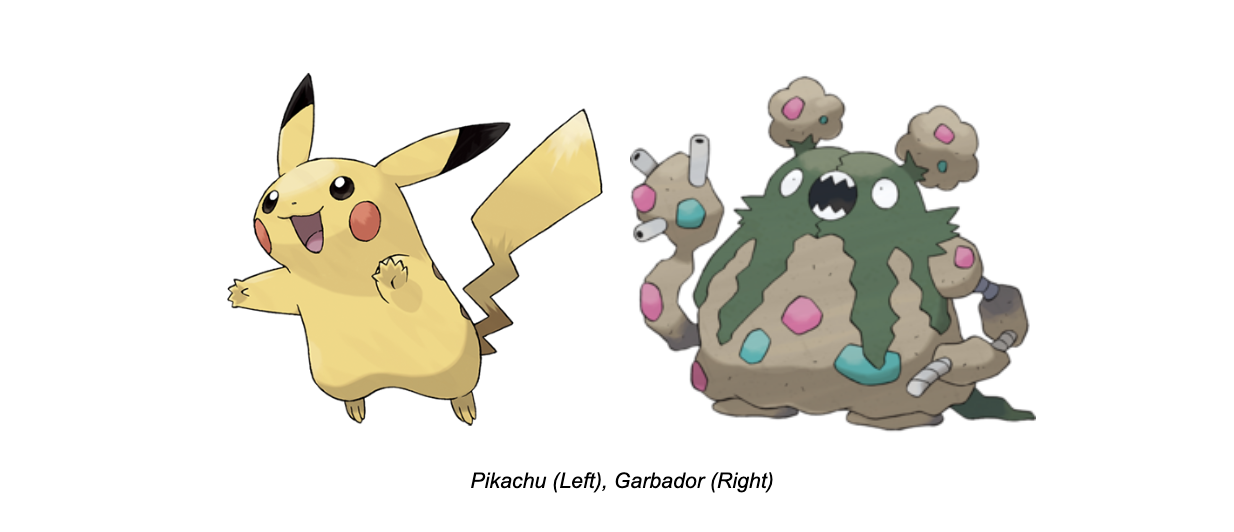
Pikachu versus Garbodor. A new collector may not know much about the franchise, but there is still a very high chance they have heard of Pikachu. The same cannot be said for Garbodor. All else being equal, most collectors would much rather own a card featuring Pikachu than one featuring Garbodor.
That difference in emotional recognition and attachment matters. The Pokémon on the card plays a major role in shaping demand, which in turn affects value. The example in your draft makes exactly this point through Pikachu’s broad recognizability versus a much less iconic Pokémon.
There are many unofficial ranked lists of the most popular Pokemon every year - if you are new to the hobby, finding confluence between such lists may be a great starting point.
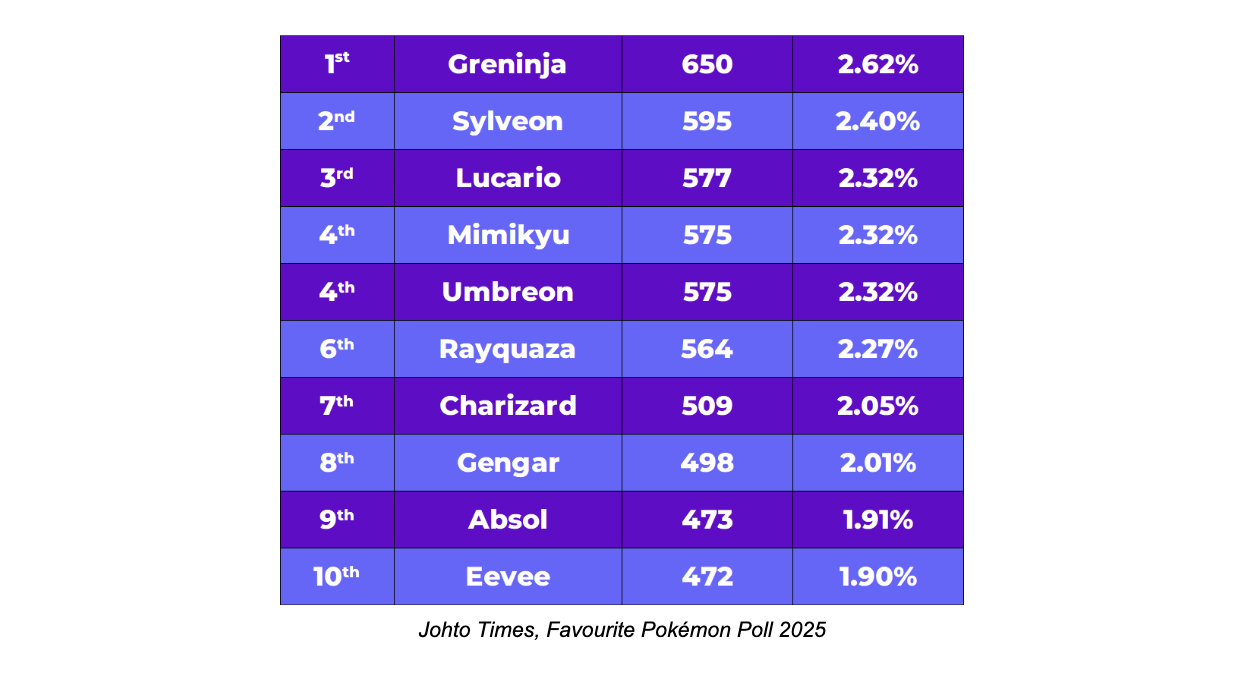
For newer participants, looking at fan polls or popularity rankings can be a useful starting point. But over time, the best way to build real intuition is to develop a genuine understanding of the franchise itself. Cultural familiarity often gives collectors an edge that raw data alone cannot.
Rarity and Scarcity
The next major factor is rarity and scarcity.
These two ideas are closely related, but they are not exactly the same. A card can be rare without being especially scarce, and it can be scarce without necessarily being rare in the traditional sense.
Properties of what can be considered as a “rare” and/or “scarce” card:
Tough to pull from a pack / set
Promo card that was available in a limited manner/quantity/period of time, and/or was tough to attain
An “old” card: a card from a set that is no longer in production, a vintage card, etc.
At first glance, rarity and scarcity may seem interchangeable. But the distinction becomes clearer with examples
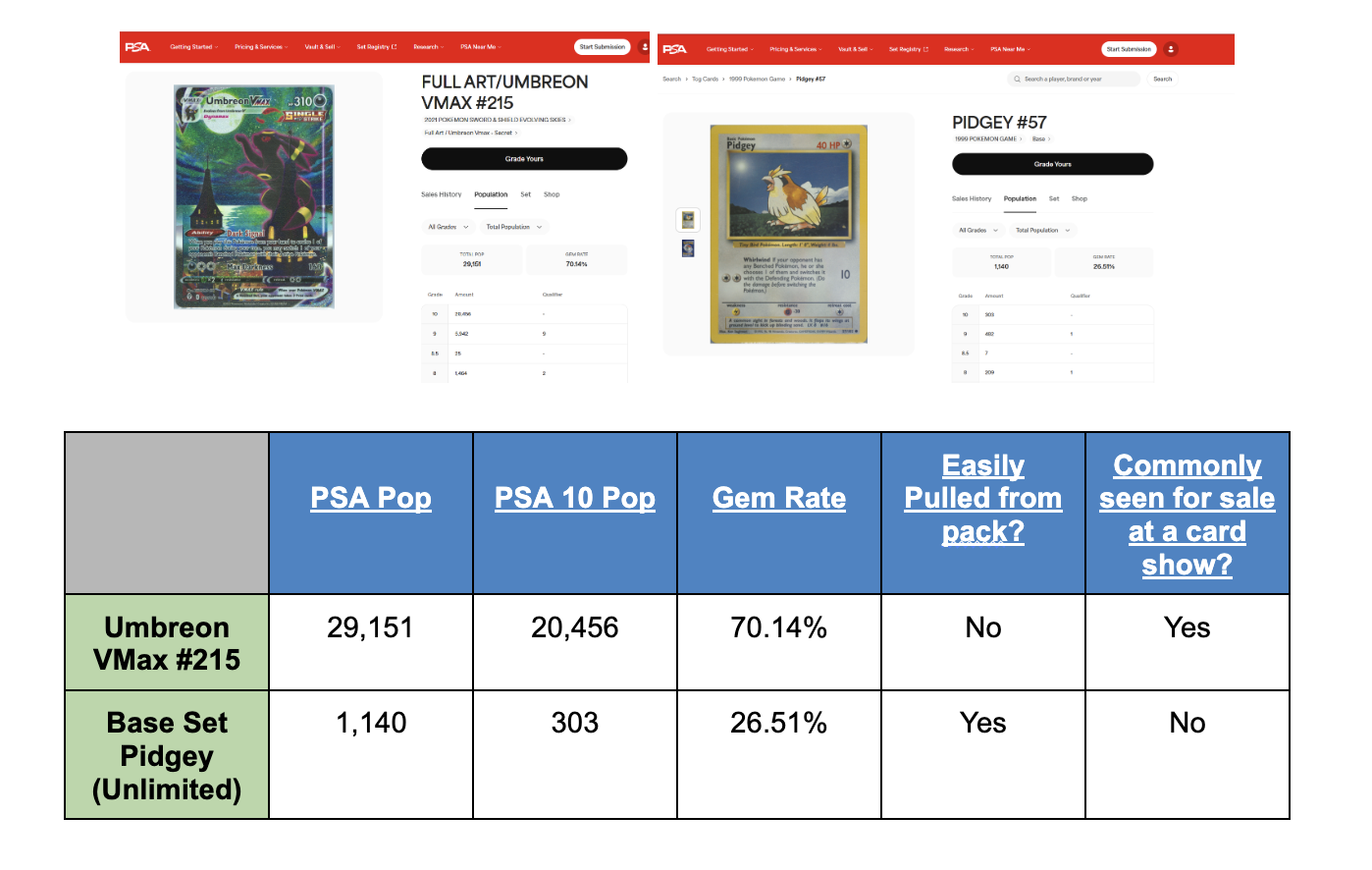
A useful comparison is Umbreon VMAX #215 (“Moonbreon”) v.s Base Set Unlimited Pidgey. Moonbreon was much harder to pull from packs, even though there are far more graded copies in circulation today. By contrast, Base Set Unlimited Pidgey was easier to pull originally, but is now seen far less often in the market due to age and lower preservation rates.
Does that make the Base Set Unlimited Pidgeys more rare? No. The Moonbreon was way harder to pull from an Evolving Skies pack, than Pidgeys were from a Base Set Unlimited pack. This is also a clear example of how people care much more to grade a Moonbreon than a Base Set Unlimited Pidgey.
A card show may have multiple PSA 10 Moonbreons available at any given time, while a PSA 10 Base Set Unlimited Pidgey may be much harder to find. That does not necessarily mean Pidgey was rarer in pack terms. It may simply be scarcer in today’s market.
For newer collectors, tools like PSA population reports can be helpful when evaluating rarity and scarcity. But numbers alone do not tell the full story. Historical context, print era, collector behavior, and market visibility all matter as well.
Popularity
The next important contributor to a card’s value is popularity and attention. Gone are the days of quiet collecting or small, silent communities. Today, with a plethora of card shows, influencers and social media content, the market is loud and highly optimized. With new entrants flooding the hobby, potential echo chambers are formed, with attention coalescing towards similar cards that the most watched influencers are bringing attention to.
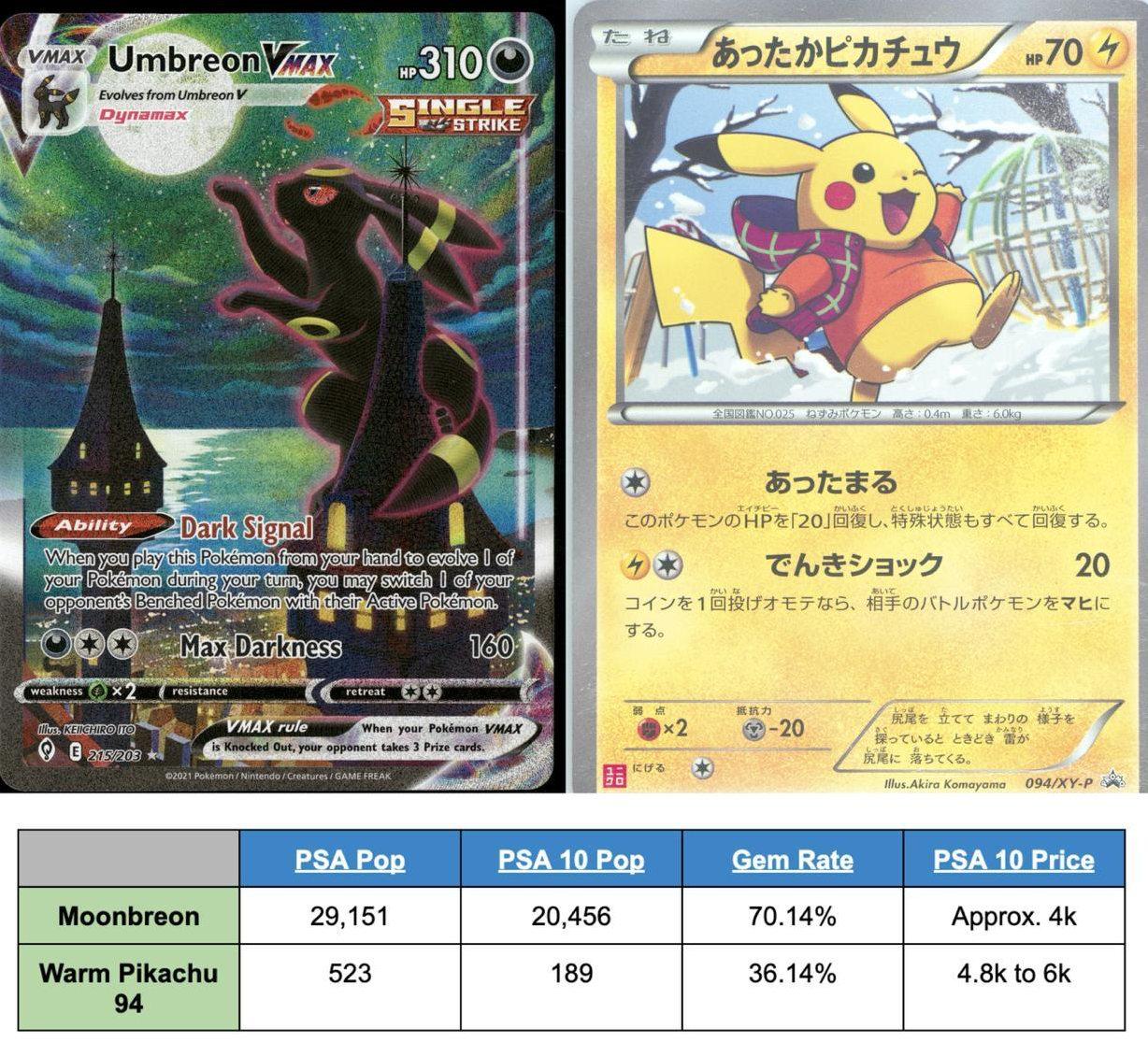
The clearest example is once again Moonbreon. Released in Evolving Skies in 2021, Moonbreon became the chase card of a set famous for difficult pull rates. Even though PSA population data shows a very large number of graded copies, demand has remained very strong because the card became one of the most recognizable and talked-about modern Pokémon cards in the hobby.
This becomes even more interesting when compared with Warm Pikachu 94, one of the 2014 Uniqlo Pikachu promos. That card is significantly rarer and scarcer based on PSA population, and it is also harder to gem at a PSA 10. Yet despite those stronger “fundamentals,” its pricing does not sit dramatically above Moonbreon.
Why?
Because popularity matters.
Moonbreon has far greater awareness, visibility, and mindshare across the hobby. More collectors know it, talk about it, chase it, and actively want it. Warm Pikachu 94 may be more limited, but it does not command the same level of widespread attention.
This is a strong example of how popularity can meaningfully influence price, sometimes even offsetting what supply-side metrics alone might suggest.
Condition: Raw and Graded
The final major factor is condition
Condition has a major impact on value whether a card is raw or graded, though the way collectors evaluate each can differ.
In general, condition is judged based on factors such as:
surface
edges
corners
centering
For ungraded cards, collectors usually describe condition using a scale such as:
Damaged (DMG)
Heavily Played (HP)
Moderately Played (MP)
Lightly Played (LP)
Very Lightly Played (VLP)
Near Mint (NM)
Gem Mint
For raw/ungraded cards, collectors typically describe the condition of cards in any of these categories. Alternatively, collectors who are experienced also utilize a card’s potential PSA grade as a form of judgement of a raw card - eg. “This card looks like a PSA 6”.
Regardless, it is important to know that for an exact same copy of a raw card, its value that can be sold for can differ greatly, solely based on its condition. We will use this Base Set Unlimited Charizard sales data to illustrate this point. Two ungraded copies sold at different prices, and the difference came down to condition. One card had visibly less whitening and stronger overall eye appeal, which supported a higher sale price.
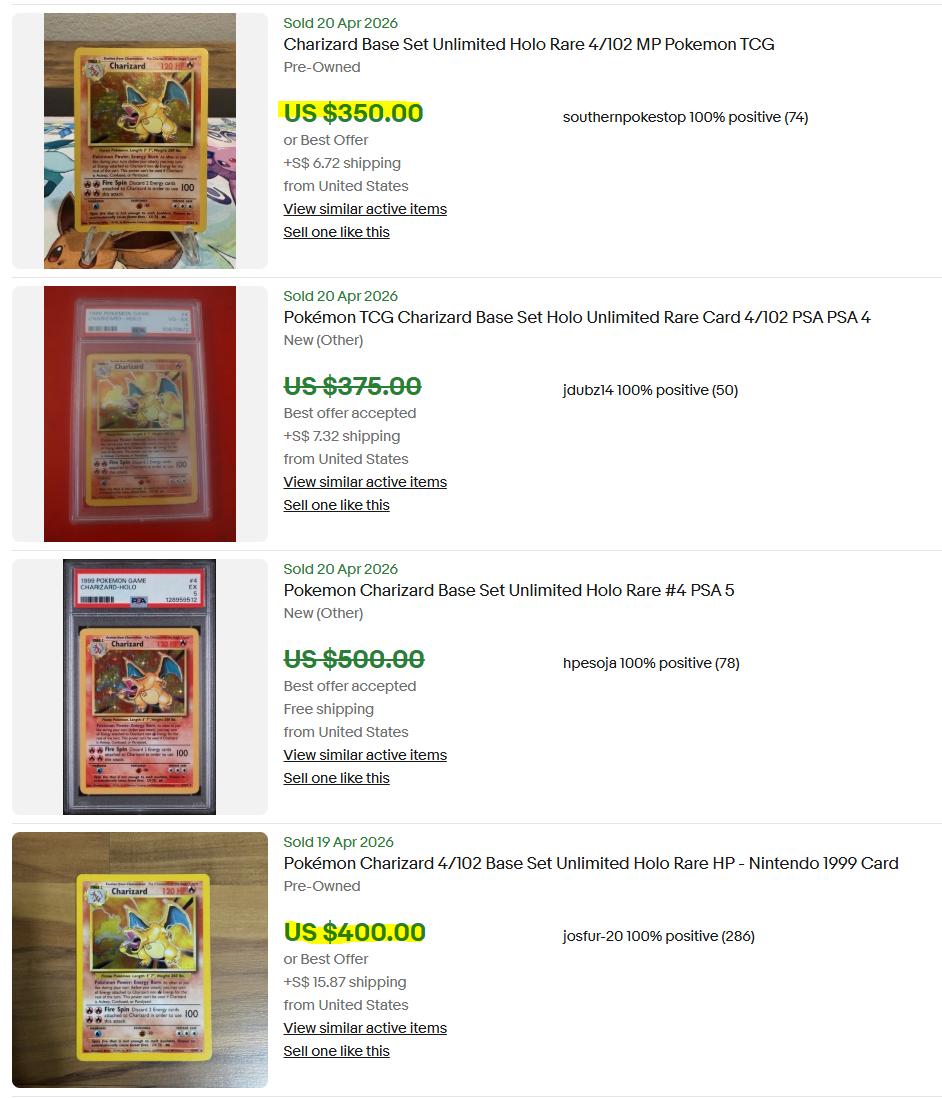
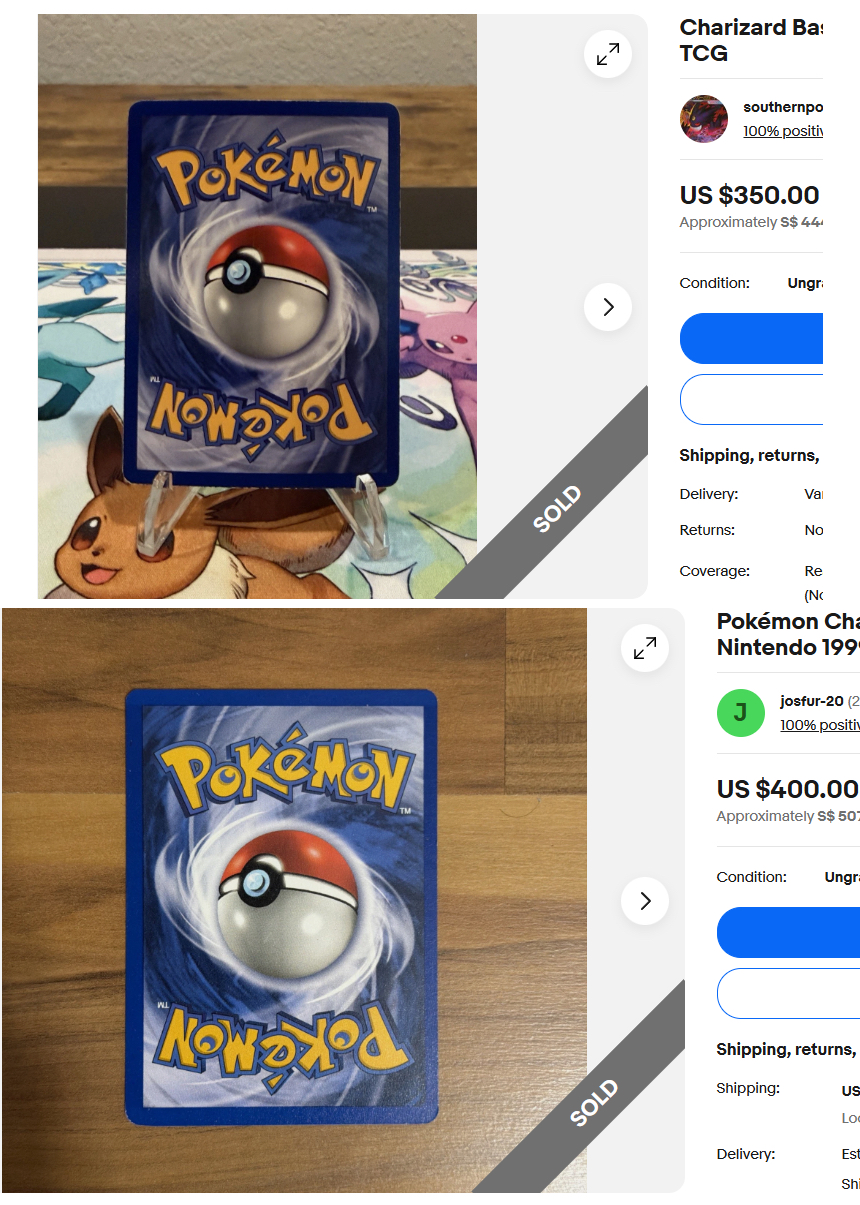
This example also highlights another important point: seller descriptions are not always accurate. A card listed as HP may in reality be in better condition than one listed as MP. Because of that, buyers should not rely only on the stated label. It is important to review actual photos carefully and understand how condition is assessed.
Collectors should examine both the front and back of a card, paying attention to centering, edges, corners, surface quality, and holofoil wear where applicable.
Graded Cards
Cards can also be submitted to grading companies and fitted into slabs.
In the Pokémon TCG market, the major grading companies each carry their own reputation and pricing dynamics.
Here is a short breakdown of the most popular grading companies, and a brief description of each:
PSA: The most dominant card grading company in the TCG collecting hobby. Cards graded by PSA are typically more liquid than other organizations. PSA graded cards also often have the most price references available, making it the easiest point of reference when buying and selling.
BGS: Once the rival of PSA, BGS was recently acquired by PSA themselves. BGS is typically known for providing not only an overall grade, but also a subgrade for each property that makes up a card’s condition. As such, BGS is known to have the highest standards of grading (ie. it is the hardest to get a 10 grade with BGS). BGS is also famous for its BGS 10 Black Label grade, in which a card is absolutely perfect in every way. Black labels often fetch up to multiples more than their BGS “normal” 10 or PSA 10 counterparts.
CGC: Once only mostly known for grading comics, CGC burst onto the TCG grading scene about 5-6 years ago. CGC 10 graded cards are typically slightly cheaper than their PSA 10 counterparts. CGC also recently released a new grade tier known as the CGC Pristine 10, deemed to be the equivalent of the BGS Black Label 10. However, CGC Pristine 10s are far from the prestige and pricing of BGS Black Label 10s. That being said, they tend to be slightly costlier than their PSA 10 counterparts.
TAG: TAG is the young breakout grading company of this cycle. Amidst mishaps and potential cases of foul play by companies like PSA, TAG started out this cycle with the identity of objectivity through AI-powered grading, void of any human bias. Many are likening it to potentially take PSA’s throne, while others believe that PSA is too dominant to lose. Regardless, TAG has gained favour amongst collectors despite its young age, but has yet to prove itself - only time will tell.
For simplicity, PSA is usually the easiest benchmark for most collectors because it has the strongest liquidity and the most comparable sales data.
As a general rule, higher grades command higher prices. A PSA 10 is worth more than a PSA 9 of the same card, and so on. But the size of that price gap varies from card to card.
In some cases, a PSA 10 may be worth several times more than a PSA 9. In others, the premium may be much smaller. Much of that comes down to gem rate - how difficult it is for that specific card to achieve a top grade.
Closing remarks
There are, of course, much nuances to each of these properties, or even more contributors to a card’s price, but this should suffice for now. Do note that there isn’t a rule of thumb, where one single factor is typically more dominant than another - it all depends on a case by case basis. We hope you found this informative and enjoyed learning about the hobby.
The more time you spend studying these dynamics, the easier it becomes to understand why certain cards command the prices they do.
We hope this guide gave you a clearer foundation for navigating the hobby. If there are other Pokémon TCG topics you’d like us to cover next, we’d love to hear them. Good luck, and happy collecting!
Written by @simplepeanut3 (on X) or @s.lowpoke_trading (on Instagram) - Research Contributor
